
You get a text out of nowhere. It says you can earn money with AI in minutes, no experience needed, just easy income running on autopilot. It sounds too good to be true, because it is. These texts are part of an AI income scam targeting Americans right now. Here’s how it works and how to spot it.
What’s behind these “AI income” texts
Scammers have been sending unsolicited texts to Americans promising fast, passive income powered by AI. In fact, they are reaching a wide audience: in an August 2025 Trend Micro global study, 59% of people said they had received a text or email offering a job or extra income. Every one of those messages leads to the same place: a fake investment website designed to steal money and personal information.
TrendLife detected over 16,000 of these AI income scam texts in early 2026, and every single one was confirmed as a scam. The site collects your name, address, phone number, and full card details, and quietly signs you up for charges you never agreed to.
How the scam works
Here’s what some of these messages actually look like (source: TrendLife):
- “TIME IS UP. Turn AI into your ATM in minutes. Set once, earn daily on full autopilot. Few spots left. Don’t wait.”
- “HOURS LEFT. Start earning with AI in minutes. Set up fast, flood your account on autopilot. Limited spots. Act now.”
Short, urgent, and vague. Once you tap the link, here’s what happens:
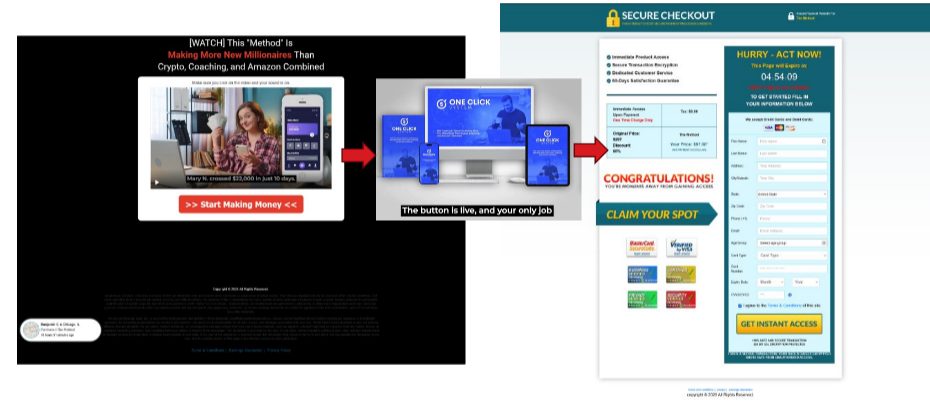
The website looks real
The landing page has a countdown timer, enthusiastic reviews, and security badges. The pressure to act is manufactured. There are no real spots running out and no real deadline. Those badges are just images, and the reviews were performed by paid actors.
The hidden monthly charge
At checkout, a pre-checked box you can’t see signs you up for a $19.93/month subscription. No confirmation email. No cancellation instructions. The charges keep coming until you catch them on a statement weeks later.
The fine print you can’t read
A legal disclaimer is buried in near-black text on a dark background. It admits that most users earn $0 and that the testimonials were performed by paid actors. It’s there, deliberately impossible to read.
The broken links
The Terms, Privacy Policy, and Disclaimer pages all lead nowhere. They exist only to look legitimate. Once you know to check, this one takes about two seconds to catch.
These tactics work because the pressure they manufacture mirrors a real one, and they’re timed to land when people are most vulnerable. The same August 2025 global study found that 47% of respondents said their income or financial security had been negatively impacted in the previous 12 months, with rising living expenses cited as the top reason. Scammers count on that pressure. If one of these texts caught your attention, that’s not a character flaw. It’s exactly what they were designed to do.
Top 6 red flags to watch for
Here’s what to look for if you receive one of these AI income scam texts:
- Unsolicited texts about earning money: Real investment platforms don’t cold-text strangers with income offers.
- Short links hiding the real destination: Links that use a short URL service are designed to obscure where you’re actually going.
- Countdown timers and “limited spots”: These are manufactured pressure tactics, not real constraints.
- Requests for card details before you’ve agreed to anything: Legitimate services don’t collect payment without clear consent.
- Legal pages and trust badges that don’t work: Legitimate sites always have functioning Terms of Service and Privacy Policy pages. On scam sites, these are window dressing. The pages go nowhere and the security badges are just decorative images.
- Unverifiable testimonials: Vague first names, stock photos, and no real profiles to check are signs the reviews were manufactured. In some AI income scams, testimonials are performed by paid actors.
Tips to stay safe from AI income scam texts
- Don’t tap links in unsolicited texts: If you didn’t request it, treat it with caution before engaging.
- Search the company name directly: Type it into Google rather than using the link in the text.
- Check your bank statements: Look for unfamiliar charges, including small recurring ones. If you shared card details, call your bank to dispute charges and get a new card issued.
- Use Trend Micro ScamCheck: If something feels off, take a screenshot and check it with Trend Micro! ScamCheck can analyze suspicious content like messages and links and tell you whether they’re a threat before you tap anything.
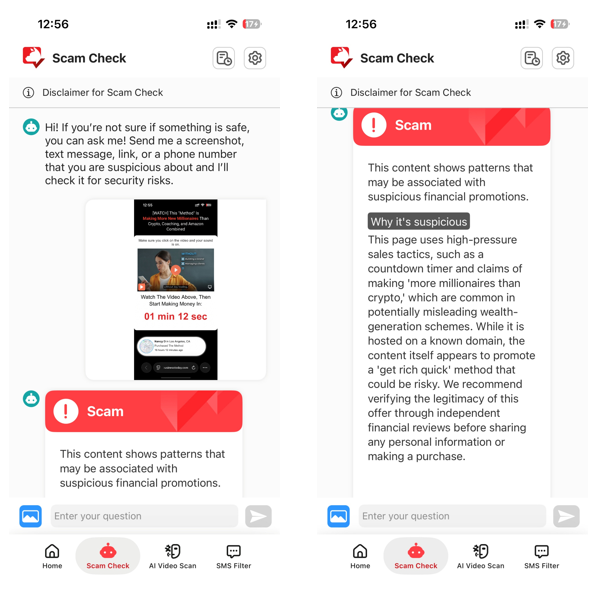
Here’s what ScamCheck thinks of the AI income website. It flagged the countdown timer and “get rich quick” claims as high-pressure tactics common in misleading wealth-generation schemes:
- Report it to the FTC: File at ReportFraud.ftc.gov to help others avoid the same thing.
- Forward the text to 7726 (SPAM): This sends it directly to your wireless carrier for review.
You’ve got this
Now that you know what to look for, you’re already ahead. Trust your instincts, take your time, and know that any unsolicited “AI income” offer isn’t one.
0 Comments
Other Topics
You Might Also Be Interested In...